Let's bypass the standard marketing vanity metrics for a moment and look at a harsh pipeline reality: Your brand is likely being ghosted by enterprise buyers before they even know you exist.
You have probably noticed that top-of-funnel web traffic is flattening, yet your product is as competitive as ever. Your sales leaders insist they are losing deals earlier in the cycle, often before a rep can even secure an introductory call.
This isn't a failure of your sales team's hustle, nor is it a problem with your ad creative. You are running into the AI Cold Start Problem at the cloud marketplace layer.
In our earlier discussions - such as our deep dive into why treating marketplaces as mere procurement infrastructure kills your visibility - we established that the AWS and Google Cloud Marketplaces have evolved into massive discovery engines. Today, that evolution has reached its logical conclusion: enterprise buyers aren't just transacting in the marketplace; they are letting embedded, conversational AI models do their foundational research for them.
When a Chief Information Officer or a Lead Cloud Architect sits down to evaluate solutions, they aren't scanning traditional software directory grids or reading marketing PDFs. They are feeding complex, multi-step prompts into native marketplace AI engines:
"Analyze the top data compliance vendors on Google Cloud Marketplace that natively integrate with BigQuery without introducing latency bottlenecks, and isolate any common deployment roadblocks reported by enterprise teams."
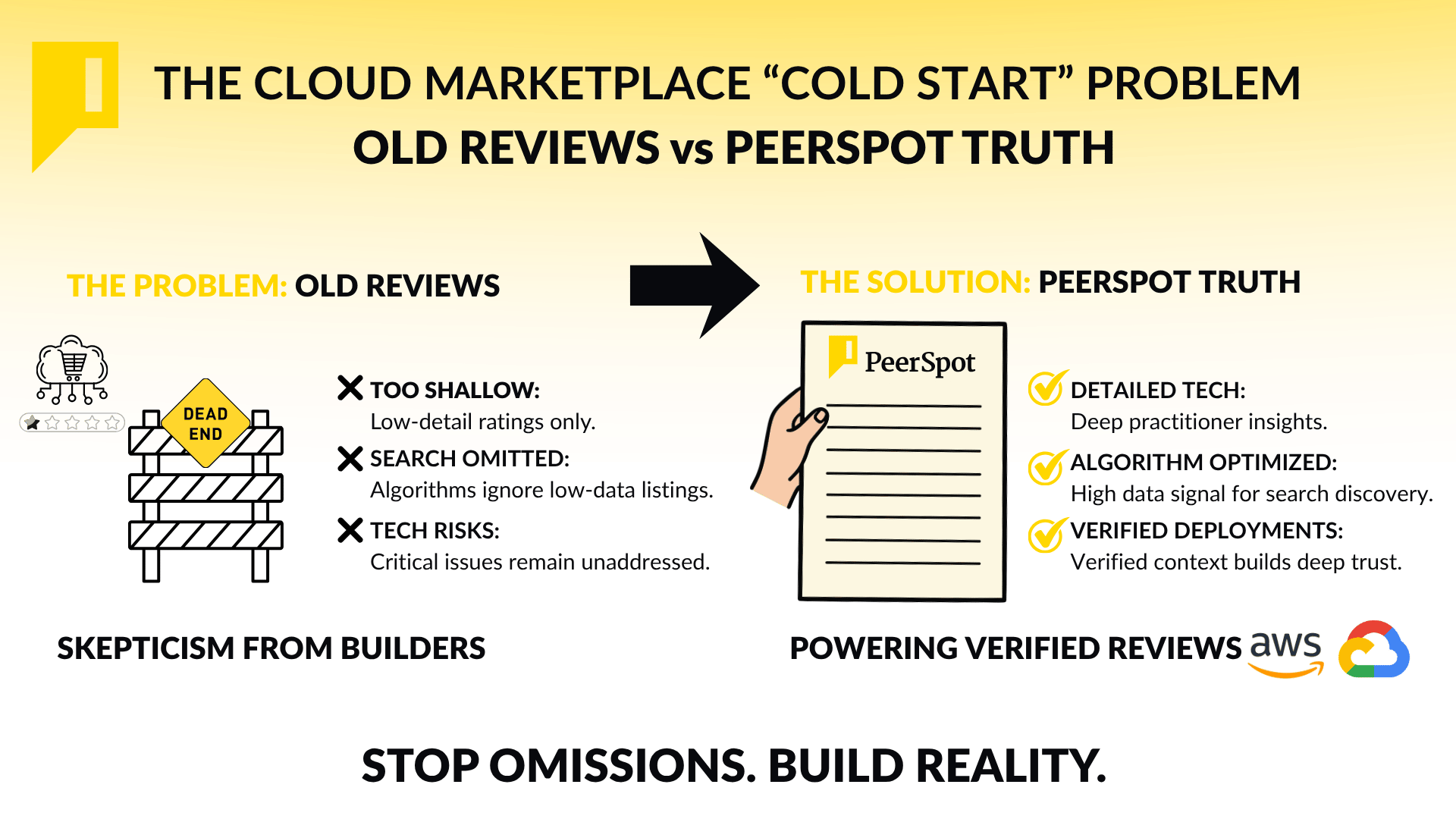
If your customer validation strategy relies on shallow, unverified reviews imported from traditional directories ("Great platform, highly recommend!"), your brand hits an algorithmic dead end. The marketplace AI cannot find the technical telemetry, operational parameters, or verified practitioner evidence it needs to answer the prompt.
The result? The model leaves you out of the summary entirely. Your product wasn't compared and rejected; it was simply omitted from the consideration set.
Why Marketplace AI Ignores Your Marketing Badges
To protect your pipeline in an AI-driven ecosystem, we have to look at how large language models actually process and synthesize enterprise software data.
In-marketplace LLMs are fundamentally indifferent to "Category Leader" badges or high-volume star counts generated on third-party public sites. They don't evaluate software based on sentiment; they parse the underlying data layer for signal density.
When a marketplace LLM weighs your solution against a competitor, it prioritizes structured, long-form technical data written by verified practitioners who manage real production risk. If your competitor's listing features deep, multi-paragraph operational evidence detailing exactly how their system handles enterprise workloads within that specific cloud ecosystem, and your listing offers fifty generic five-star clicks, the algorithm will cite your competitor every single time.
Anchoring Authentic Proof in the Scrape Layer
As a CMO, your mandate is to ensure your product is visible wherever enterprise dollars are allocated. To beat the AI Cold Start Problem, you must feed the marketplace discovery engines the exact raw data they require to recommend you.
This demand for structural, non-gameable truth is precisely why AWS and Google Cloud Marketplace integrated PeerSpot directly into their native transaction and review frameworks.
PeerSpot completely bypasses the superficial checklist approach to user feedback. By utilizing an analyst-led methodology, it extracts granular, long-form insights from actual enterprise practitioners, creating technical assets that average over 600 words of deep prose anchored right where the buying intent is highest.
- Contextual Data Fuel: PeerSpot reviews explicitly document actual deployment barriers, specific compliance configurations, and post-purchase support realities. This provides the exact contextual data tokens that marketplace AI engines crave when mapping solutions to an enterprise's unique cloud footprint.
- Transaction-Verified Authority: Because PeerSpot reviews inside the marketplace are validated against actual cloud ledger transactions, they carry an unassailable trust rating. The recommendation algorithms recognize these inputs as verified operational telemetry rather than synthetic marketing noise.
The CMO Action Plan: Auditing Your Algorithmic Footprint
To ensure your brand secures its rightful placement in deep-funnel marketplace AI research, your marketing organization must realign its customer proof pipeline:
- Conduct an AI Visibility Audit: Test your primary enterprise use cases inside the conversational search modes of AWS and Google Cloud. See if your product is generated in the final summary. If it isn't, analyze the source data of the competitors the models are choosing to cite.
- Mandate Structural Depth Over Vanity Volume: Redirect your customer advocacy teams away from chasing low-signal, high-volume review spikes on public directories. Tie your KPI success to data density - capturing balanced, multi-paragraph accounts from your technical champions (DevOps leads, Solutions Architects, and CISOs).
- Embed Proof at the Point of Transaction: Stop treating customer validation as a detached web-traffic asset. Deploy transaction-verified review engines like PeerSpot directly onto your marketplace listings to ensure your technical proof is native, verified, and instantly legible to the cloud algorithms.
The Bottom Line: If the marketplace machines cannot find verified operational reality on your listing, your brand ceases to exist in the modern enterprise funnel. It's time to stop optimizing for human clicks on legacy grids and start building high-signal technical proof where the marketplace AI goes to learn.
Jennifer Geisler is Chief Marketing Officer at PeerSpot, where she leads global marketing strategy, brand, demand generation, customer advocacy, and AI-driven initiatives. A seasoned technology executive, Jennifer has helped lead two successful IPOs and has built and scaled marketing organizations across cybersecurity, SaaS, AI, and enterprise technology companies. Known for turning customer insight into market influence, she is passionate about helping technology buyers make more informed decisions and helping vendors better understand the voice of their customers.



.png)