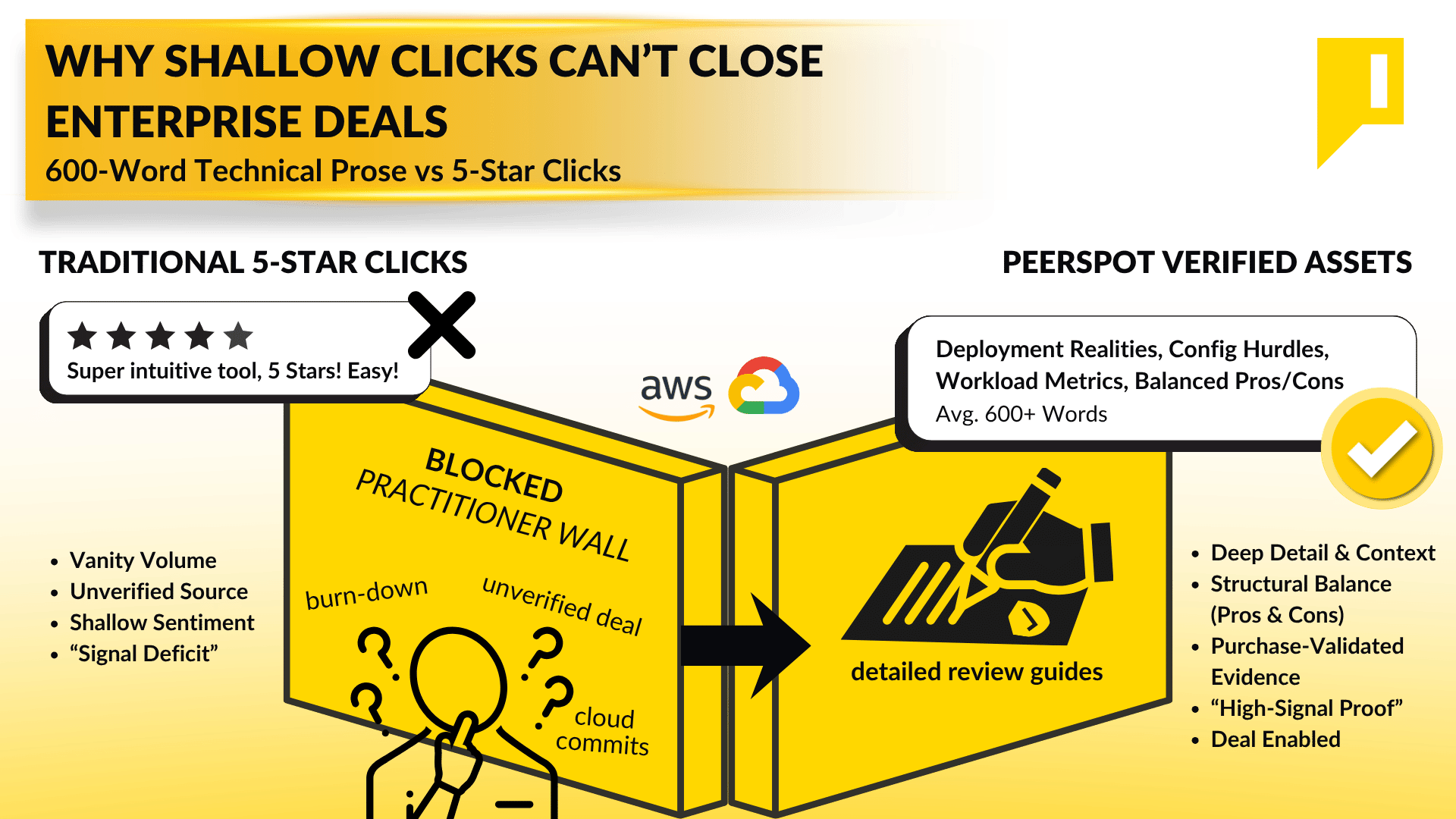
For years, B2B marketing teams treated review platforms as a set it and forget it channel. That model worked when buyers simply wanted validation. It fails in a market that demands advice. Today, relying on a single, static platform for customer voice creates a hidden structural risk in your go-to-market engine. It leaves you exposed to relevance risk — your data no longer influences buyers — and operational risk — your content flow creates zero leverage for sales. The era of the 5-star validation stamp isn't necessarily over, but its ability to drive decisions is.
The Two Risks of a Static Strategy
Modern B2B buyers are no longer asking is this product good. They are asking: what tradeoffs should I expect in real deployments, what broke during implementation, and how does this actually compare in practice. Star ratings and binary feature grids do not answer these questions. Detailed peer advice does. The second risk is operational — traditional review models are passive. When review momentum slows, your sales team is left without fresh collateral.
![]()
Three Forces Exposing Your Strategy
Buyers demand risk mitigation not just validation: B2B purchases are high-stakes. Buyers need peer insight that reduces risk. A 4.5-star rating doesn't reduce risk. A detailed story about a successful migration does.
LLMs summarize insight not stars: AI-driven research tools do not extract meaning from ratings alone. They surface language, context, and experience. If your review strategy doesn't generate deep text, your brand becomes invisible in AI-driven discovery.
AWS Marketplace is now a decision layer: AWS Marketplace is no longer just a transaction channel — it is an evaluation environment. Buyers compare solutions side-by-side and look for decision-grade peer advice.
The Solution: Diversification, Not Replacement
Leading teams are rethinking their single-vendor dependency. They aren't necessarily rushing to rip and replace their legacy platforms. Instead, they are adopting a parallel approach — standing up a second active system to run alongside their existing program. This acts as a form of insurance. Not a replacement, but a way to maintain continuity and control as buyer behavior evolves.
By running these systems in parallel, you ensure that if one stream slows down, the other keeps customer voice flowing to sales and marketing. The smartest strategies today aren't reactive. They are designed with optionality. Customer voice is too critical to rely on a single aging point of failure. The market has shifted from validation to advice. Your strategy needs to shift from collecting stars to generating content.
Trent Conley is the Director of Marketing at PeerSpot, where he focuses on demand generation, customer-driven marketing, and AI-powered content strategy for enterprise technology vendors. He specializes in turning verified customer expertise into high-impact marketing programs that drive visibility, trust, and pipeline. Trent writes about B2B marketing, marketplace strategy, AI-driven discovery, customer proof, and how modern buyers research enterprise technology solutions.


.jpeg)