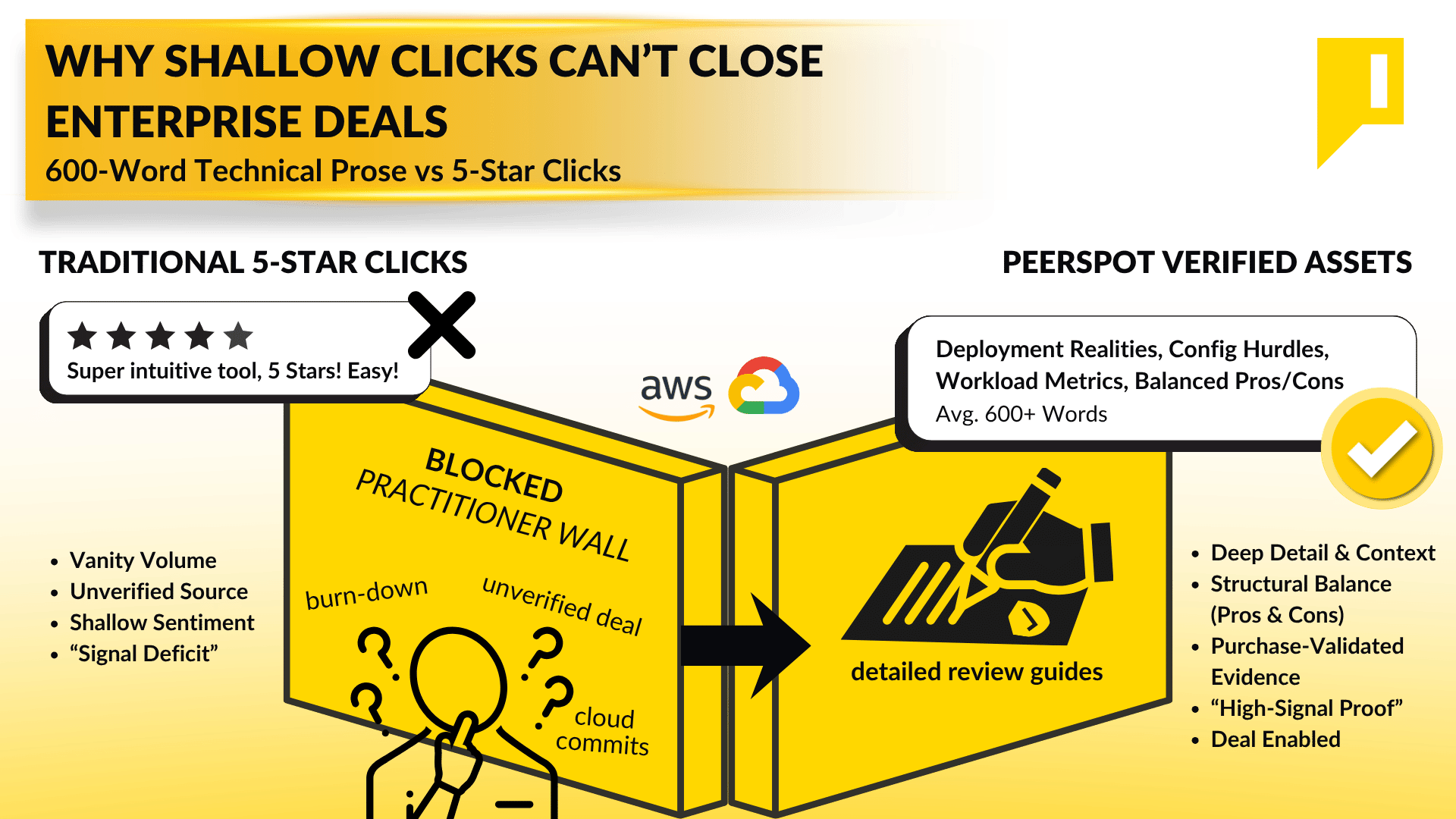
If you are a B2B technology marketer, you have likely been trained to chase volume. Run a review generation campaign, offer a gift card, and secure a sudden spike of 5-star clicks on a traditional software directory to climb a category grid.
That playbook functions perfectly well if you are selling a low-touch SaaS tool to a small business. But if you are selling complex enterprise software inside the AWS or Google Cloud Marketplace, that volume-centric strategy is actively working against you.
Enterprise buying committees are highly risk-averse. When an IT Director, a Chief Data Officer, or a Lead Systems Engineer encounters a product with a perfect 5.0 rating built entirely on short, unverified reviews like "Super intuitive software, highly recommend!", their alarm bells go off.
To a technical practitioner, that isn't proof. It's a marketing illusion. They know how easily broad public review directories can be manipulated with synthetic influence and incentivized review spikes.
In our previous piece, Why "Buy Now" Isn't Enough: Solving Late-Stage Architectural Bottlenecks in Cloud Marketplaces, we explored how empty sentiment fails to get you past the Practitioner Wall. To understand why, you have to look at the anatomy of the data itself.
![]()
The High-Signal Difference
In enterprise cloud procurement, the quality of your customer proof is measured by its signal density, not its volume. A single, exhaustive review written by a verified practitioner carries more weight than fifty surface-level badges.
A high-signal review that influences a late-stage enterprise buyer must include:
1. Transaction Verification — Tied directly to hyperscaler ledger
2. Deep Contextual Scope — Roles, environment scales, strict data
3. Structural Balance — Clear pros, raw cons, configuration caps
4. Deployment Realities — How it connects to native cloud APIs
When a review contains that level of structural depth, it ceases to be a mere testimonial. It becomes an authoritative, third-party case study that engineers and procurement officers use to mitigate implementation risk. They aren't looking for a cheerleader; they are looking for a deployment blueprint.
Building a Built-In Trust Infrastructure
This demand for non-gameable truth is why the infrastructure layer of cloud marketplaces has fundamentally evolved. When AWS built out its native product feedback guidelines and Google Cloud Marketplace integrated PeerSpot, they did it to establish a trusted framework for enterprise validation.
Because PeerSpot reviews inside the marketplace are validated against actual cloud transactions, they provide an unassailable record of performance.
The Analyst-Led Approach: PeerSpot captures these insights through deep interviews and targeted prompts, turning customer feedback into multi-paragraph technical assets that average over 600 words.
The Revenue Multiplier: These high-signal reviews do more than convert marketplace visitors; they feed the internal recommendation engines used by AWS and Google Cloud field reps during co-sell operations, making it easy for them to defend your software inside their strategic accounts.
Next Steps: Upgrade Your Proof Portfolio
To build a high-signal validation engine that enterprise buyers actually trust, your customer marketing teams must move away from volume metrics:
De-prioritize Star Clicks: Evaluate your current customer reference asset library. If your reviews can fit into a single tweet, they lack the data density required to influence an enterprise cloud buyer.
Capture Balanced Technical Prose: When interviewing customers for case studies or marketplace reviews, actively prompt them for the hard details. Ask about their scaling limits, how they resolved initial configuration bottlenecks, and exactly how they tuned their environment. Balance creates credibility.
Embed Verification at the Transaction Layer: Anchor your customer voice where the spend happens. Deploy transaction-verified review frameworks like PeerSpot directly on your marketplace listings to ensure your proof is native, visible, and unassailable.
The Bottom Line: Focus your strategy on verification depth rather than vanity volume. One transaction-verified, long-form practitioner review embedded where the enterprise money lives will do more for your pipeline velocity than a thousand unverified directory clicks ever could.
Jennifer Geisler is Chief Marketing Officer at PeerSpot, where she leads global marketing strategy, brand, demand generation, customer advocacy, and AI-driven initiatives. A seasoned technology executive, Jennifer has helped lead two successful IPOs and has built and scaled marketing organizations across cybersecurity, SaaS, AI, and enterprise technology companies. Known for turning customer insight into market influence, she is passionate about helping technology buyers make more informed decisions and helping vendors better understand the voice of their customers.



.png)